
Framework / GDPR
GDPR for your AI systems, alongside the EU AI Act.
An AI system can raise questions about lawful processing, information to people and impact assessment. Fencia helps organize documentation against selected GDPR obligations so a privacy professional can review possible gaps alongside the AI Act work.
GDPR coverage in Fencia is partial. It is a starting point for documentation review, not a full GDPR audit or a determination that processing is lawful.
 GDPR / AI recommendations
 Live product
GDPR and the EU AI Act, side by side
GDPR for AI: the data protection work behind your AI tools
17 GDPR requirements that matter most when AI processes personal data — principles and accountability, purpose limitation, minimisation, DPIA, processors — with the documents and evidence that back each one.
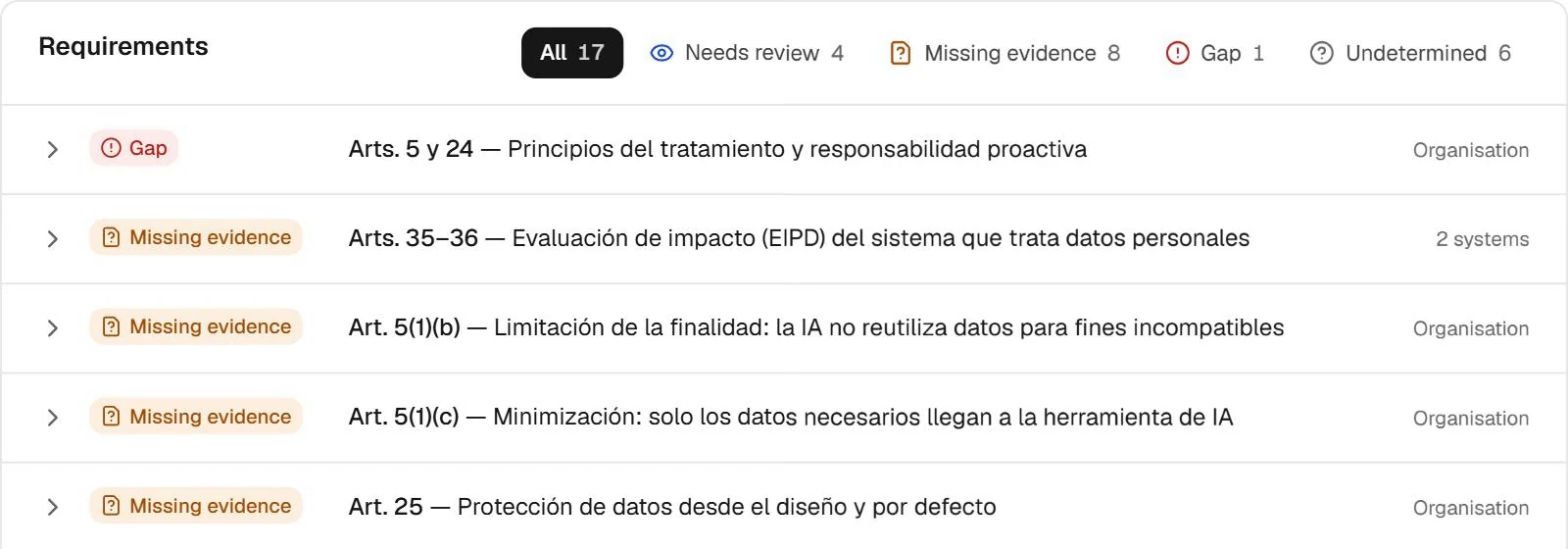
The articles that matter when AI touches personal data
Principles and accountability, the impact assessment for systems that process personal data, purpose limitation, minimisation and data protection by design: each with its state and whether it applies to the organisation or to a system.
Missing evidence is told apart from a real gap
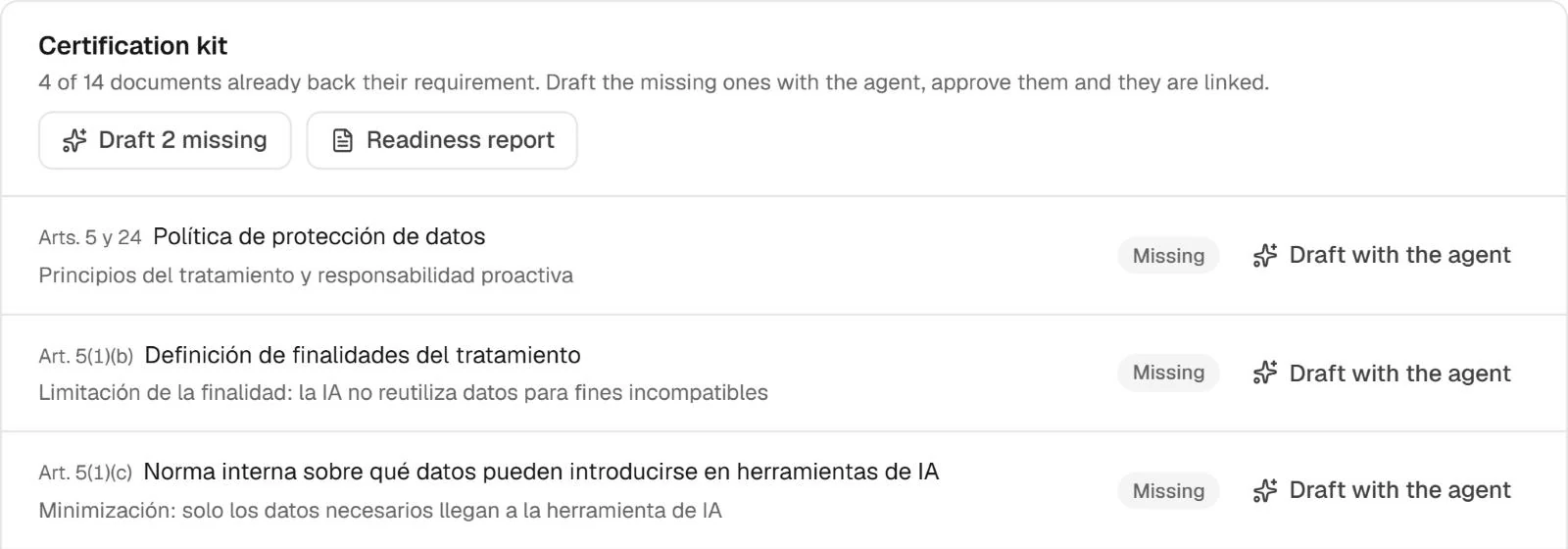
The documents a DPO will ask for
The kit lists the documents behind each requirement: data protection policy, purposes of processing, the internal rule on what data can go into AI tools, retention policy and more. Missing ones can be drafted with the agent.
An approved document counts as needs review, not as met
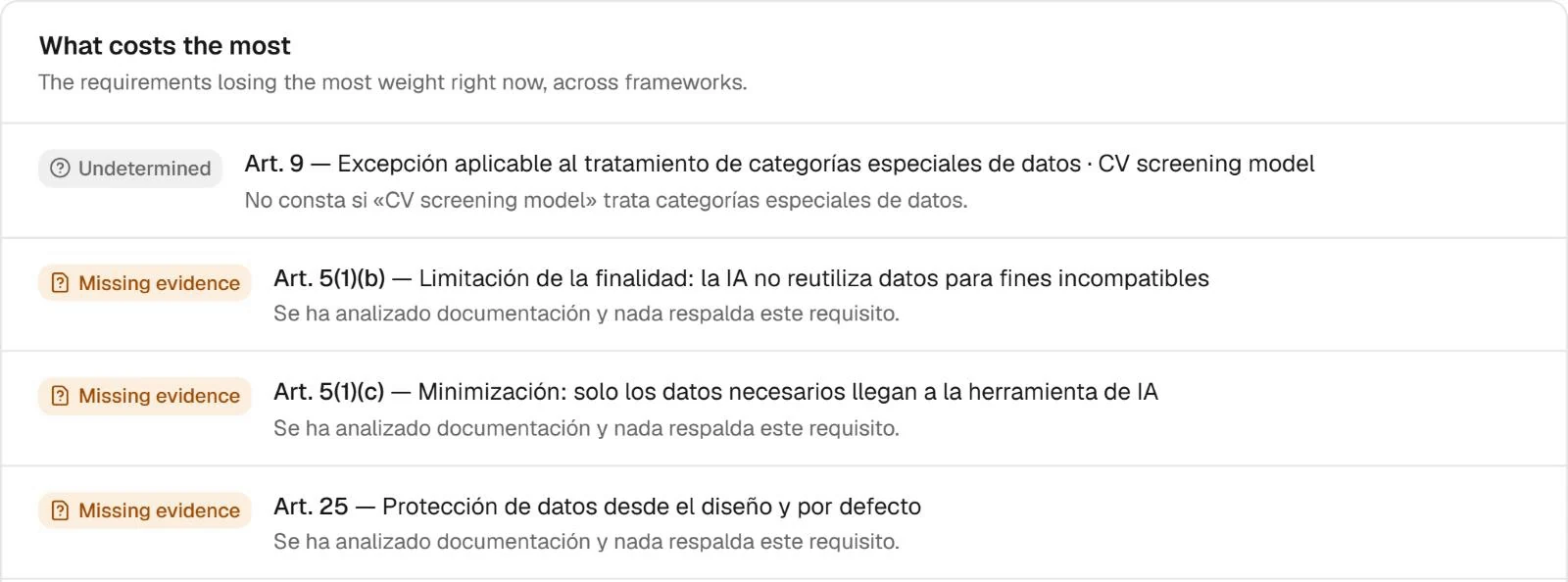
Start where the gap costs most
Fencia ranks the requirements losing the most weight across frameworks, so a privacy lead knows which question to settle first — for example, whether a CV screening model processes special categories of data.
Each line says why the requirement is losing weight
Real Fencia screens from a test workspace. Names and data are fictional.
The supported slice
Useful coverage, with a clear boundary.
The current Fencia register (2026-10-15.1) includes selected GDPR requirements relevant to AI use. The Regulation covers far more than this scanner evaluates.
Read the GDPR on EUR-Lex- Data processing context
- Fencia can organize possible documentation gaps around selected lawful-basis, purpose and data-handling requirements. It cannot choose a lawful basis for you.
- Information to people
- Source material can be reviewed against covered information duties. The adequacy of a notice depends on the real processing and its audience.
- Impact assessment
- Relevant records can be linked to DPIA-related questions in the register. Whether a DPIA is required and sufficient needs case-specific review.
- Outside this review
- Fencia does not analyze all GDPR articles, perform a complete privacy audit or give a legal opinion about a controller’s compliance.
GDPR questions before you start
Fencia links GDPR work to your AI systems without treating one framework as proof of another. A privacy professional judges what is missing and why.
Is this a full GDPR audit?
No. Fencia covers 17 core GDPR requirements most affected by AI use. It cannot choose a lawful basis for you or give a legal opinion on your compliance.
Can it analyse our privacy policy?
Yes. Upload it, or paste its public URL from Starter, and the covered GDPR gaps come back with their passage.
Does it tell me whether I need a DPIA?
It links records to the DPIA requirement for systems that process personal data. Whether a DPIA is required and sufficient needs case-specific review.
Where is the data processed?
AI analysis runs in the EU (Microsoft Azure, EU data zone). Before each call, emails, phone numbers, ID numbers, IBANs, cards and keys are replaced with pseudonyms.
Put your AI use next to your GDPR work
Analyse a privacy policy or an AI policy and see the GDPR and EU AI Act gaps side by side.